Various Business Health and Service Life: A Visual Framework for Clarity and Connection
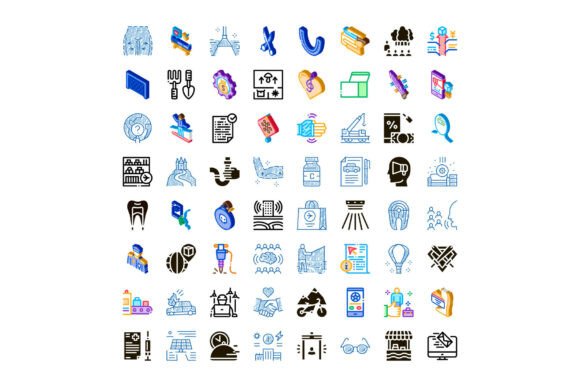
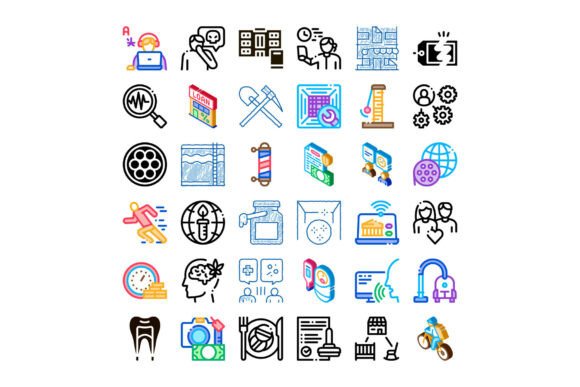
Various Business Health and Service Life is not a software tool, a certification program, or a consulting methodology. It is a conceptual visual language — built around diverse, hand-crafted doodle icons — that maps abstract organizational and personal dynamics into tangible, communicable form. At its core, it represents an intentional bridge between how systems function (business health), how they endure (service life), and how people experience them (lifestyle, communication, technology, and service delivery). Unlike rigid frameworks or prescriptive models, Various Business Health and Service Life offers flexibility through illustration: each icon stands for a distinct idea — a feedback loop, a user journey, system resilience, digital trust, wellness integration, or cross-team alignment — yet gains meaning only in relation to others.
What Makes Various Business Health and Service Life Distinct?
The distinction lies in its dual nature: it is both conceptual and visual, designed not to replace analysis but to accelerate shared understanding. Where traditional business diagrams rely on standardized flowcharts or UML notation — often opaque to non-technical stakeholders — these doodle-style icons use approachable, human-scale imagery. A simple sketch of interlocking gears might represent operational interdependence; a stylized heart with circuit lines could signal the convergence of employee well-being and IT infrastructure health; a speech bubble wrapped around a leaf may illustrate sustainable communication practices.
This isn’t decorative art. Each icon is intentionally ambiguous enough to invite interpretation, yet grounded enough to anchor discussion. That balance supports collaborative workshops, internal documentation, dashboard design, and even early-stage product wireframing — especially where clarity across departments (e.g., HR, engineering, customer support) matters more than technical precision.
How It Compares With Other Visual and Conceptual Tools
Various Business Health and Service Life occupies a unique space between several common resources:
- Standard icon libraries (e.g., Font Awesome, Noun Project) offer breadth and consistency but rarely convey layered, domain-specific meaning. Their icons are functional — “settings,” “user,” “cloud” — not interpretive. Various Business Health and Service Life icons are curated for resonance, not universality.
- Infographic templates provide structure but often enforce fixed narratives. In contrast, Various Business Health and Service Life invites modular assembly: you choose which icons reflect your current challenge — say, declining team morale (lifestyle) paired with rising ticket resolution time (service life) — then arrange them to surface relationships, not just report status.
- Business frameworks like OKRs, Lean Canvas, or Service-Dominant Logic deliver rigor and process. Various Business Health and Service Life doesn’t compete with those — it complements them. You might sketch a doodle of a growing plant beside a “customer retention” KPI to visualize long-term service vitality, or place a shield-and-wireframe icon next to a “cybersecurity policy” objective to emphasize human-system trust.
This isn’t about replacing analytical depth. It’s about lowering the barrier to initiating that depth — particularly when audiences include designers, frontline staff, or leadership without domain-specific fluency.
Strengths and Practical Fit
The primary strength of Various Business Health and Service Life is adaptive legibility. Because the icons are conceptual rather than literal, they scale across contexts:
- A healthcare startup might use a stethoscope-dotted server rack icon to communicate “clinical data integrity meets infrastructure reliability.”
- A remote-first education platform could pair a Wi-Fi symbol with a sleeping moon to represent “asynchronous learning support without burnout.”
- An urban transit agency might layer a bus icon with heartbeat lines and a calendar grid to model “service frequency, rider health impact, and seasonal demand shifts.”
It works best when the goal is alignment, not automation — when teams need to co-define what “healthy growth” or “sustainable service” means *for them*, not apply a generic definition. Its strength is in facilitation: sparking questions like, “Does this icon capture how our support team actually experiences workload?” or “Where does ‘technology’ end and ‘communication’ begin in this workflow?”
Tradeoffs and Limitations
There are real tradeoffs. Because the icons rely on interpretation, they require shared context to avoid misalignment. Without brief facilitation or light annotation, a “cog-and-leaf” icon might read as “eco-friendly machinery” to one person and “operational sustainability metrics” to another. This isn’t a flaw — it’s a feature — but it means Various Business Health and Service Life demands modest investment in framing, especially for new users.
It also lacks built-in measurement or tracking. You won’t find dashboards, API integrations, or automated reporting tied to these icons. They describe states and relationships, not real-time data. If your priority is live monitoring of SLA compliance or predictive churn modeling, Various Business Health and Service Life won’t replace those tools — but it can help your team agree *what* to monitor and *why*.
Finally, scalability requires curation. A set of 20 thoughtfully grouped icons adds clarity; 150 loosely related doodles introduce noise. The value emerges from selective, purposeful use — not exhaustive coverage.
When It’s the Right Choice — and When It Isn’t
Consider Various Business Health and Service Life if you’re:
- Designing internal training or onboarding materials where abstract policies (“data governance,” “inclusive service design”) need relatable entry points;
- Preparing stakeholder presentations for mixed audiences (e.g., engineers, clinicians, finance leads) and want visuals that prompt dialogue, not passive reception;
- Mapping service journeys where emotional tone, system dependencies, and human capacity all shape outcomes — and clipart or stock vectors feel reductive;
- Building custom dashboards or reports and want intuitive, branded visual metaphors instead of generic charts;
- Conducting strategic retreats and need low-stakes, tactile ways to explore tradeoffs like “speed vs. resilience” or “innovation vs. continuity.”
It’s less suitable if you need:
- Regulatory-compliant documentation with auditable definitions;
- Real-time performance benchmarking against industry standards;
- Automated alerts or workflow triggers based on service thresholds;
- High-fidelity prototyping for developer handoff (where pixel-perfect UI specs matter more than conceptual resonance).
Making an Informed Decision
Choosing whether Various Business Health and Service Life fits your needs comes down to two questions: What kind of clarity do you need right now — and for whom? If the gap is conceptual — a lack of shared mental models, misaligned priorities, or difficulty translating strategy into daily practice — then its illustrative, open-ended nature becomes an asset. If the gap is technical — missing integrations, insufficient data granularity, or compliance requirements — then it’s better used alongside, not instead of, other tools.
Also consider implementation effort. Adopting Various Business Health and Service Life doesn’t require licensing, training modules, or vendor contracts. It asks for attention: time to select icons that resonate, space to discuss what they imply, and willingness to revise interpretations as understanding deepens. That makes it unusually accessible — and unusually dependent on thoughtful use.
In practice, many teams start small: adding one or two icons to a quarterly review slide, sketching a service-life timeline during a sprint retrospective, or using lifestyle-themed doodles to reframe wellness initiatives beyond annual surveys. The power isn’t in completeness — it’s in relevance. When an icon helps someone say, “Yes — that’s exactly the tension we’ve been avoiding,” then Various Business Health and Service Life has done its work.