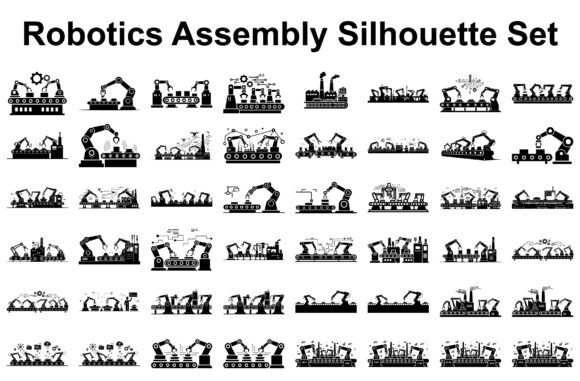
Robotics Assembly Silhouette Set: Precision Visual Assets for Industrial Design and STEM Communication
Visual clarity matters—especially when communicating complex technical concepts. In engineering documentation, manufacturing dashboards, educational curricula, or industrial branding, a well-chosen graphic can replace paragraphs of explanation. The Robotics Assembly Silhouette Set meets this need with surgical precision: it’s not merely a collection of robot outlines, but a thoughtfully engineered library of scalable, production-ready silhouettes built for real-world application across disciplines.
Why Silhouettes—Not Full-Color Illustrations—Are Strategic in Technical Contexts
Silhouettes occupy a unique functional niche. Unlike detailed illustrations that risk visual clutter or stylistic bias, clean black-and-white outlines prioritize recognition over decoration. They reduce cognitive load, scale without artifacting, and integrate seamlessly into diverse color schemes—critical when designing factory floor signage, academic slide decks, or responsive web interfaces for automation software.
This principle is embedded in every file of the Robotics Assembly Silhouette Set. Each silhouette avoids unnecessary texture, gradient, or shadow—focusing instead on anatomical accuracy and mechanical fidelity. A robotic arm isn’t just “a shape that looks like an arm”; its joint articulation, end-effector geometry, and base mounting points reflect real kinematic constraints. Conveyor systems show belt tension indicators; PLC cabinets include standardized I/O port spacing; collaborative robots (cobots) display rounded safety contours aligned with ISO/TS 15066 guidelines.
Format Flexibility That Matches Real-World Production Workflows
A single design asset rarely serves only one purpose. An educator may project a PNG during a classroom lecture, then embed the same SVG into an interactive web simulation. A packaging designer might import an EPS into Adobe Illustrator for die-cutting templates, while a laser engraving studio uses the same vector to drive a CO₂ cutter. The Robotics Assembly Silhouette Set anticipates these parallel paths by delivering 50 distinct robotics and machinery motifs—each available in four native formats:
- SVG (Scalable Vector Graphics): Ideal for web use, animations, and responsive UI components. Maintains crisp edges at any resolution and supports CSS manipulation—useful for interactive infographics showing assembly line sequencing.
- PNG (Portable Network Graphics): Offers transparent backgrounds and pixel-perfect rendering for digital presentations, LMS platforms (like Moodle or Canvas), and social media assets where vector support is limited.
- JPG (Joint Photographic Experts Group): Optimized for high-fidelity print output—especially effective for large-format posters, trade show banners, and training manuals where file size and compatibility trump editability.
- EPS (Encapsulated PostScript): Industry-standard for professional print workflows, including offset lithography and CNC routing. Preserves vector integrity for precise cutting paths in fabrication environments.
This cross-format consistency eliminates format-conversion guesswork—a common bottleneck when repurposing assets across departments. No more tracing low-res JPGs into vectors or wrestling with rasterized shadows in SVG exports.
Use Cases Across Diverse Professional Domains
The strength of the Robotics Assembly Silhouette Set lies in its domain-agnostic utility. Below are concrete examples illustrating how different users deploy these assets—not as decorative flourishes, but as functional tools:
Educators Building STEM Literacy
High school robotics instructors use the silhouettes to construct annotated assembly diagrams for VEX or FIRST Robotics kits. A teacher in Ohio overlays the robotic gripper silhouette onto a physical kit photo, labeling each servo position and torque specification. At the university level, mechanical engineering faculty embed conveyor and gantry system silhouettes into thermodynamics problem sets—asking students to calculate power draw based on depicted motor configurations.
Manufacturing Teams Documenting Workflow Improvements
Lean practitioners mapping value streams don’t rely on clip art. Instead, they combine silhouettes of CNC lathes, AGVs (automated guided vehicles), and vision inspection stations to build accurate, non-proprietary process maps. One automotive supplier used the set to redesign their internal SOPs—replacing ambiguous text like “robot places part” with a specific silhouette of a Fanuc M-20iD variant, annotated with cycle time and sensor feedback points.
Designers Crafting Industrial Brand Identity
A Berlin-based automation startup integrated the articulated robotic arm silhouette into its logo lockup—not as a standalone icon, but as a negative-space element within the letter “A”. The same silhouette appears scaled down in website headers, printed on service technician uniforms, and embossed on aluminum nameplates—all maintaining legibility and brand cohesion thanks to consistent vector geometry.
Hobbyists and Makers Prototyping Concepts
On forums like Reddit’s r/3Dprinting or Hackaday.io, users share parametric CAD models alongside visual context. A maker developing a modular sorting system uploaded a Fusion 360 render flanked by three silhouettes from the set: a delta robot, a linear actuator, and a hopper feeder. This allowed peers to immediately grasp scale, orientation, and integration intent—without needing to interpret perspective distortion or lighting artifacts.
Technical Rigor Behind the Simplicity
“Clean curves and precise detailing” isn’t marketing language—it’s a measurable outcome. Each silhouette undergoes multi-stage validation:
- Reference Alignment: Sourced from manufacturer datasheets, ISO standards documentation, and publicly available CAD libraries—not generic stock imagery.
- Path Optimization: Bezier curves minimized to essential anchor points, ensuring smooth scaling without bloated file sizes (<5 KB average SVG size).
- Consistent Stroke Weighting: All elements adhere to a 2pt stroke baseline, enabling uniform line thickness when grouped or layered—critical for stenciling or vinyl cutting.
- Export Fidelity Testing: Every file is rendered at 4K resolution, printed at 300 DPI, and imported into Cricut Design Space, Silhouette Studio, and Adobe Illustrator to verify no path corruption or anti-aliasing errors.
This rigor explains why the set performs reliably across platforms like Cricut Maker (for fabricating training jigs) or Silhouette Cameo (for creating tactile learning cards for visually impaired students). It’s designed for interoperability—not just aesthetics.
Strategic Considerations for Implementation
While the Robotics Assembly Silhouette Set offers broad utility, effective deployment requires intentionality:
- Avoid Over-Abstraction: Silhouettes excel at representing known objects—but shouldn’t substitute for custom schematics in safety-critical documentation. Always pair them with technical annotations or reference numbers per ISO 80000-2 standards.
- Contextual Color Coding: Though delivered in monochrome, the set gains meaning through strategic coloring. Use red for emergency stop devices, green for powered-on states, and amber for warning zones—aligning with IEC 60204-1 electrical safety conventions.
- Licensing Clarity: The bundle permits commercial use—including resale in derivative products like printable STEM activity packs—but prohibits redistribution of raw files. Educators embedding silhouettes into open-access OER (Open Educational Resources) should retain attribution in metadata, not visible labels.
- Version Control: As automation hardware evolves (e.g., mobile cobots with LiDAR housings), consider supplementing the core set with user-generated additions—maintaining a local library tagged by year and standard revision (e.g., “ISO_10218-1_2023_cobot_base”).
Connecting Visual Language to Industry Evolution
The rise of Industry 4.0 hasn’t diminished the need for clear visual language—it’s intensified it. With digital twins, AI-driven predictive maintenance dashboards, and human-robot collaboration spaces becoming commonplace, stakeholders from plant managers to software developers must share a consistent visual vocabulary. The Robotics Assembly Silhouette Set functions as that shared lexicon: a neutral, precise, and reproducible foundation upon which domain-specific meaning is layered.
Consider a pharmaceutical packaging line integrating vision-guided robots. A maintenance technician reviewing an augmented reality overlay doesn’t need photorealistic rendering—they need instantly recognizable silhouettes of the camera mount, reject chute, and servo controller, positioned accurately relative to physical fixtures. That recognition speed translates directly into reduced downtime.
Similarly, when policymakers draft regulations around autonomous material handling, illustrative annexes using standardized silhouettes prevent ambiguity. A silhouette of a lift truck with integrated obstacle detection conveys regulatory scope more effectively than descriptive prose alone.
In essence, the Robotics Assembly Silhouette Set bridges abstraction and application—not by oversimplifying complexity, but by distilling it into reusable, authoritative visual units. Its value isn’t in what it adds, but in what it removes: guesswork, inconsistency, and miscommunication. For anyone translating robotics concepts into tangible outcomes—whether on a factory floor, in a classroom, or on a screen—the set isn’t just convenient. It’s foundational.