Diverse Business and Healthcare Related: A Unified Visual Language for Modern Professionals
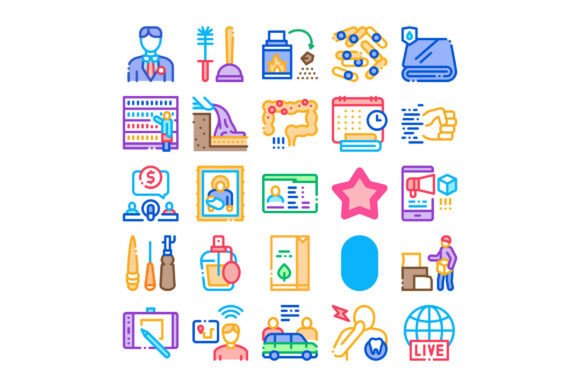
In today’s interconnected professional landscape, clarity, speed, and cross-disciplinary fluency are no longer optional—they’re essential. Enter Diverse Business and Healthcare Related: a thoughtfully curated collection of colorful outline icons that bridge traditionally siloed domains—business, healthcare, logistics, marketing, and technology—into a single, cohesive visual vocabulary. More than just decorative assets, these icons serve as cognitive anchors: intuitive, scalable, and context-aware tools designed for infographics, presentations, SaaS interfaces, educational modules, and collaborative workspaces.
What “Diverse Business and Healthcare Related” Actually Means
The term Diverse Business and Healthcare Related refers not to a product category or software platform, but to a deliberate design philosophy—one that recognizes how deeply intertwined modern workflows have become. A hospital administrator evaluating supply chain resilience uses the same mental models as a logistics startup optimizing delivery routes for telehealth kits. A digital health marketer crafting a campaign for remote patient monitoring leans on the same data visualization principles as a fintech growth lead analyzing user acquisition funnels.
This collection reflects that convergence. Each icon is built with consistent stroke weight, proportional spacing, and a harmonized color palette—yet each retains domain-specific fidelity. A stylized heartbeat line doubles as a growth curve; a network node evokes both cloud infrastructure and clinical care coordination; a delivery truck icon integrates subtle medical cross motifs without compromising legibility in a logistics dashboard.
Why It Fits Naturally Into Today’s Professional Ecosystem
Three macro-trends make Diverse Business and Healthcare Related especially timely:
- Cross-Functional Collaboration Is Now Standard Practice. Teams no longer operate in verticals. Product managers at health-tech startups routinely co-design with clinicians, operations leads, and compliance officers. Marketing teams build campaigns grounded in clinical outcomes data. Icons that speak across disciplines reduce translation friction—and accelerate shared understanding.
- Visual Literacy Has Become a Core Professional Skill. From pitch decks to internal training portals, professionals increasingly communicate complex ideas through visuals—not paragraphs. Research from the University of Minnesota shows that audiences retain 65% more information when text is paired with relevant, consistent imagery. The Diverse Business and Healthcare Related set delivers semantic precision: an icon for “patient journey mapping” doesn’t look like “customer lifecycle”—it conveys clinical nuance while remaining instantly scannable.
- Design Systems Are Scaling Beyond UI Kits. Leading organizations—from academic medical centers to global consulting firms—are adopting unified design systems that extend into slide templates, workshop materials, and even printed toolkits. These icons aren’t isolated assets; they’re interoperable components. They scale cleanly from mobile app buttons (16px) to keynote slides (256px), support dark-mode contrast ratios, and export seamlessly to SVG, Figma, and PowerPoint.
Changing Needs Driving Adoption
Professionals aren’t just seeking prettier graphics—they’re solving real workflow pain points:
For Entrepreneurs & Founders
Early-stage health-tech founders often wear five hats: clinician liaison, regulatory strategist, growth marketer, operations planner, and investor communicator. When building a pitch deck, using a single visual language for “value-based care model,” “real-time analytics dashboard,” and “multi-channel patient engagement” signals operational maturity—even before the first line of code ships. One founder recently shared how switching from generic stock icons to Diverse Business and Healthcare Related assets reduced investor follow-up questions about scope by 40%, because visuals clarified intent faster than bullet points.
For Marketers & Content Creators
Healthcare marketing faces unique constraints: regulatory guardrails, audience fragmentation (providers vs. patients vs. payers), and high-stakes messaging. Generic “growth” or “teamwork” icons risk misalignment—e.g., a handshake icon may imply partnership, but lacks specificity for interoperability between EHR systems. The Diverse Business and Healthcare Related set includes nuanced variants: a shield icon with embedded data streams (for cybersecurity in health IT), a pill bottle with Wi-Fi waves (for connected pharmacy solutions), or a bar chart overlaid with a stethoscope (for outcomes-based reporting). These subtleties build trust and reduce ambiguity.
For Educators & Instructional Designers
Medical schools now embed business fundamentals into clinical curricula; MBA programs integrate case studies on value-based reimbursement and AI-augmented diagnostics. Teaching these intersections demands visuals that avoid oversimplification. A lecture on “supply chain ethics in PPE distribution” benefits from an icon that merges logistics flow with ethical markers (e.g., a globe with balanced scales and cargo containers)—not two separate, disconnected symbols. That coherence supports deeper conceptual integration for learners.
Practical Integration Across Tools and Contexts
These icons thrive where clarity meets action:
- In SaaS Onboarding Flows: A telehealth platform uses the “patient intake” icon (a clipboard with pulse waveform) alongside “insurance verification” (a document with badge checkmark) and “calendar sync” (a calendar with cloud upload arrow)—all drawn in the same style, reinforcing system unity.
- In Strategy Workshops: Facilitators print large-format icon sets for sticky-note mapping—grouping “clinical workflow bottlenecks,” “revenue cycle touchpoints,” and “digital engagement channels” under shared visual themes. Participants report higher alignment during synthesis phases.
- In Public Health Campaigns: Local health departments adapting national CDC guidelines use the “community outreach” icon (a megaphone with diverse silhouettes) alongside “vaccine equity” (a syringe with equal sign) and “data transparency” (a dashboard with open lock)—ensuring consistent tone across multilingual print, SMS, and social assets.
Looking Ahead: Visual Consistency as Strategic Infrastructure
As AI accelerates content creation, the role of intentional iconography grows more critical—not as decoration, but as semantic infrastructure. Generative tools can draft reports or suggest campaign copy, but they don’t inherently understand that “patient satisfaction” and “customer NPS” carry distinct regulatory, emotional, and operational weight. Human designers and communicators do. That’s why Diverse Business and Healthcare Related isn’t about replacing judgment—it’s about equipping professionals with a precise, shared lexicon.
This isn’t trend-driven design. It’s response-driven design: shaped by rising demand for interoperability across sectors, tightening compliance expectations, and the daily reality that a single project—say, launching a remote chronic care program—requires fluency in clinical protocols, payer contracting, UX research, HIPAA-compliant tech architecture, and empathetic behavior-change messaging.
When icons reflect those complexities honestly—not flattening them into generic metaphors—they become more than illustrations. They become enablers of alignment. They help a nurse educator explain care coordination to a finance team. They let a logistics analyst visualize cold-chain integrity for mRNA vaccines without needing a clinical glossary. They allow a freelance designer to deliver a presentation that resonates equally with C-suite executives and frontline staff.
In short, Diverse Business and Healthcare Related represents a quiet but meaningful shift: from seeing icons as surface-level polish to recognizing them as foundational elements of professional communication—designed not for one industry, but for the spaces where industries meet, merge, and move forward together.
Whether you're refining a go-to-market strategy, building a learning module, or visualizing a new care delivery model, these icons offer more than aesthetic cohesion. They offer conceptual fidelity—a visual shorthand rooted in real-world complexity, ready to support the next generation of cross-domain problem solving.