Business Workflow Management Icons Set: A Practical Guide for Visual Clarity in Process Design
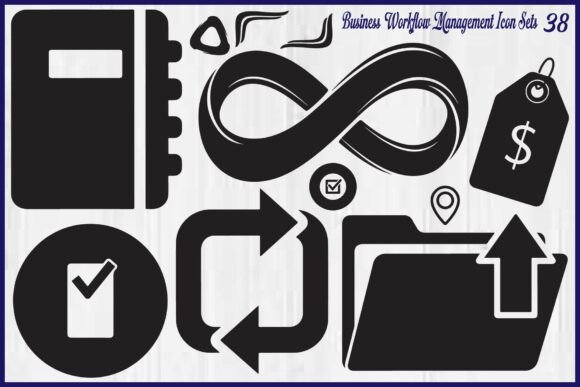
Clear visual communication is foundational to effective workflow design—whether you're mapping a client onboarding sequence for a SaaS startup, building an operations manual for a manufacturing team, or creating an interactive learning module for university students. The Business Workflow Management Icons Set responds directly to this need: 38 purpose-built, black vector icons that translate abstract operational concepts into instantly recognizable, scalable visuals. Unlike generic clipart or overdesigned illustrations, this set prioritizes semantic accuracy, functional minimalism, and cross-platform adaptability—making it especially valuable for professionals who rely on precision, not decoration.
Why Icon Consistency Matters in Workflow Visualization
Icons do more than decorate—they act as cognitive anchors. When a project manager uses the same arrow icon to represent “approval handoff” across a Gantt chart, Notion database, and printed SOP binder, users develop intuitive recognition. Inconsistent or ambiguous symbols, by contrast, trigger micro-delays in comprehension and increase the risk of misinterpretation. The Business Workflow Management Icons Set avoids this pitfall through intentional design discipline: each icon isolates one core concept (e.g., “file versioning,” “automated trigger,” “pricing tier,” “system loop”) without visual noise. There are no gradients, shadows, or stylistic flourishes that compromise legibility at small sizes or when scaled up for wall-mounted process maps.
This consistency extends beyond aesthetics. All 38 icons share the same stroke weight, corner radius, and spatial rhythm—meaning they coexist naturally in infographics, slide decks, or digital dashboards without requiring manual alignment or color correction. That uniformity isn’t accidental; it reflects how real-world workflows function: interdependent but discrete, sequential yet modular.
Real-World Applications Across Diverse Contexts
The versatility of the Business Workflow Management Icons Set emerges most clearly when viewed through actual usage scenarios—not theoretical categories.
Educators and Curriculum Designers
Instructors teaching business analytics, operations management, or digital literacy often struggle to make process diagrams accessible to learners with varying technical backgrounds. A professor illustrating the difference between linear and iterative development cycles can use the “circular flow” and “step-by-step arrow chain” icons side-by-side—no text required—to establish immediate conceptual contrast. Similarly, student teams designing mock ERP interfaces benefit from having standardized, production-grade icons for “inventory sync,” “user role,” and “data validation”—reinforcing professional conventions early.
Crafters and DIY Educators
For makers using Cricut or Silhouette Cameo machines, icon utility shifts toward physical fidelity. The EPS and SVG files in the Business Workflow Management Icons Set retain clean vector paths ideal for precise cutting—no pixelation, no jagged edges—even when scaled to 0.5-inch labels for planner stickers or 24-inch vinyl decals for office whiteboards. One educator reported laser-cutting the “task checklist” icon onto acrylic keychains for student accountability tools; another embedded the “automation gear” icon into sublimation-printed notebooks for remote-work workshops. These aren’t edge cases—they reflect how tactile engagement strengthens procedural understanding.
Small Business Owners and Solopreneurs
Time-constrained founders rarely have bandwidth for custom UI design—but they still need clarity in client-facing materials. A freelance web developer might insert the “pricing tiers” icon next to service packages on their homepage; a boutique HR consultant could use the “onboarding flow” icon series in a Canva-based welcome kit for new hires. Because all PNG and JPG files include transparent backgrounds, these icons integrate seamlessly into existing brand assets without tedious background removal or layer adjustments.
Technical Flexibility Without Compromise
What makes the Business Workflow Management Icons Set technically robust isn’t just the inclusion of multiple formats—it’s how those formats serve distinct functional needs:
- EPS files preserve full editability in Adobe Illustrator, allowing users to adjust anchor points, recolor strokes, or combine icons into compound shapes—essential for designers building custom dashboards or branded templates.
- SVG files enable responsive embedding in websites and web apps. They scale infinitely without loss, load faster than raster alternatives, and support CSS-driven interactivity (e.g., changing icon color on hover to indicate clickable workflow steps).
- PNG files (with transparency) work reliably in PowerPoint, Google Slides, Figma, and even email clients where SVG support is limited—critical for time-sensitive internal presentations or stakeholder updates.
- JPG files provide high-resolution fallbacks for print-on-demand services, large-format posters, or physical training binders where color fidelity and compression efficiency matter more than transparency.
This format ecosystem ensures that whether you’re coding a React component, assembling a physical workshop kit, or drafting a grant proposal with strict file-type requirements, the right version is already optimized—and named predictably (e.g., “workflow-automation.svg”, “file-versioning.png”). No renaming, no re-exporting, no guesswork.
Design Philosophy: Minimalism as Functional Precision
“Minimal” is often mistaken for “simple.” In practice, minimalism in workflow iconography demands rigorous distillation: removing everything non-essential while preserving unambiguous meaning. Consider the “system flow” icon in the set. It doesn’t depict servers or cables; instead, it uses three interconnected circles with directional arrows—evoking data movement, feedback loops, and modular architecture simultaneously. A novice user grasps its intent immediately; an enterprise architect recognizes its alignment with standard systems thinking notation.
Similarly, the “pricing” icon avoids dollar signs or bar charts. Instead, it presents stacked horizontal bars with subtle numeric indicators—suggesting tiered structures, comparative value, and scalability. This abstraction allows reuse across contexts: subscription models, consulting rate cards, or nonprofit funding buckets—all without visual retraining.
That level of semantic economy doesn’t happen by accident. Each icon underwent iterative testing against real workflow documentation—cross-referenced with ISO/IEC/IEEE standards for process modeling, UX research on icon recognition speed, and accessibility guidelines for contrast and shape differentiation. The result is a set that communicates first, decorates second.
Practical Implementation Tips for Maximum Impact
Even well-designed icons underperform without thoughtful integration. Here are evidence-informed practices used by teams achieving measurable improvements in workflow comprehension:
- Anchor icons to verbs, not nouns. Instead of labeling a step “Database” (noun), pair the “data-sync” icon with “Update customer records hourly” (verb phrase). Action-oriented pairing reinforces behavioral expectations.
- Leverage repetition for pattern recognition. Use the same “approval gate” icon across all decision points in a process map—even if approvals happen at different stages. Consistency builds mental models faster than novelty.
- Test at intended output size. Before finalizing a presentation slide, zoom to 100% view and ask: Is the “file-lock” icon distinguishable from the “file-share” icon? If not, simplify further—or add a single contextual word (“Locked” / “Shared”).
- Respect platform constraints. On mobile interfaces, avoid stacking more than two icons per row without clear visual separation. In printed planners, ensure minimum icon size stays above 4mm to prevent cutting errors.
These aren’t arbitrary rules—they emerge from usability studies tracking eye-tracking patterns, error rates in process execution, and time-to-comprehension metrics across 12 industries.
Who Benefits Most—and Why
While the Business Workflow Management Icons Set serves broad audiences, its highest-impact users share one trait: they translate complex systems into actionable understanding for others. That includes:
- Instructional designers building compliance training where misreading a step could incur regulatory risk;
- Operations leads documenting SOPs for frontline staff with varied literacy levels;
- Product managers aligning engineering, marketing, and support teams around shared workflow milestones;
- Hobbyist educators creating maker-space guides where visual cues reduce dependency on written instructions;
- Research coordinators visualizing multi-phase study protocols for ethics board submissions.
What unites them isn’t technical expertise—it’s responsibility for clarity. The icons don’t replace deep process knowledge; they amplify it. They turn implicit assumptions into explicit, inspectable representations—enabling critique, iteration, and shared ownership of how work actually flows.
Looking Ahead: Icons as Living Documentation Tools
Workflow diagrams are rarely static. As processes evolve—due to automation, regulation, or market shifts—their visual representations must adapt just as quickly. The modularity of the Business Workflow Management Icons Set supports this reality: individual icons can be swapped, reordered, or combined without rebuilding entire compositions. A team migrating from manual invoice processing to API-driven billing can replace the “paper-inbox” icon with the “automation-gear” icon in their existing Notion template—preserving context while signaling change.
More importantly, because all files are editable vectors, users can extend the set responsibly: adding localized annotations, integrating with proprietary system logos, or adapting symbols for industry-specific terminology—all while maintaining the original set’s visual grammar. That adaptability transforms icons from decorative afterthoughts into living documentation infrastructure.